
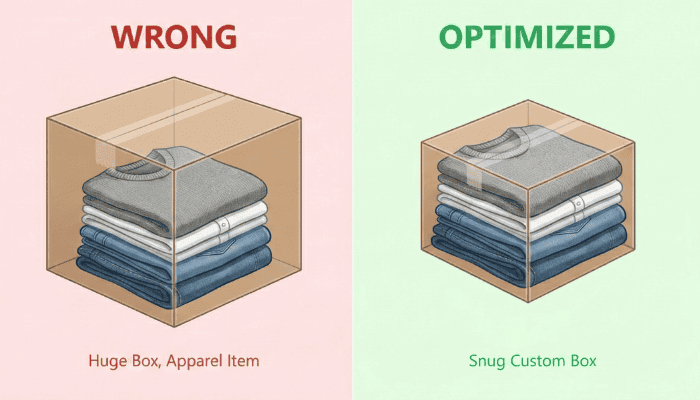
In logistics, you don’t just pay for weight; you pay for space. If you are shipping a t-shirt in a box designed for a winter jacket, you are paying the courier to ship air.Most D2C founders in India spend weeks negotiating ₹2 off their shipping rates with aggregators. Yet, many overlook the nuances of volumetric weight calculation in India, causing them to lose ₹20 to ₹35 per order simply due to poor box selection.
This is the "Air Tax."
At Varun Logix, we view packaging as a financial function. If your warehouse team is picking the "nearest available box" without an SOP, your unit economics are bleeding silently.
The Mathematics of Margin Loss
In India, the standard volumetric formula for most surface and air couriers (BlueDart, Delhivery, Ecom Express) is:

The result is the "Volumetric Weight" in kilograms. The courier compares this to the "Dead Weight" (actual weight) and charges you for whichever is higher.
Note: While 5000 is the standard divisor for domestic ecommerce, some express air services may use 4500 or 6000 depending on specific carrier contracts. Always check your SLA.
The "2cm Error"
Here is a calculation we ran for a Hyderabad-based apparel client to show the cost of "air."
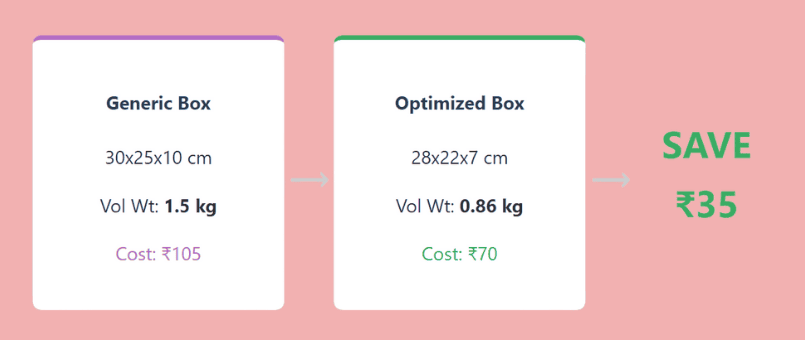
Scenario: Shipping a hoodie (Actual weight: 1.0 kg).
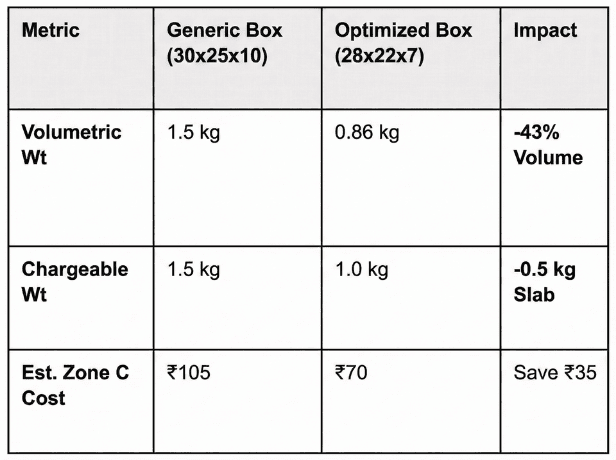
By reducing the box height by just 3 cm, the chargeable weight dropped by a full 500g slab. Geometry is a financial metric.
Why Your Packaging Strategy is Failing
Most brands fail here because they treat packaging as a procurement task rather than a fulfillment strategy.
The "Standard Box" Trap
New sellers often buy standard 3-ply boxes from local vendors in Begum Bazar or Indiamart because the MOQs are low.
These "standard" sizes are rarely optimized for specific SKUs. If you have 5 cm of empty headspace in your box, you are paying for it. Bubble wrap fills the void to protect the product, but it does not reduce the shipping cost.
The Poly Mailer Risk
This is a contrarian view, but poly mailers are not always cheaper.
Many operators assume bags are better because they have no rigid dimensions. However, automated courier hubs use laser profilers to scan dimensions.
If a picker throws a t-shirt into a poly mailer without folding it flat, the bag "bunches up." The scanner measures the bag at its widest and highest point—often the bulge. We have seen scenarios where a messy poly mailer scanned at higher volume than a rigid, flat box.
Operational Fixes You Can Implement Today
You don't need a new 3PL to fix this. You need a ruler and a spreadsheet.
Step 1: The SKU Audit
Download your weight reconciliation report from your shipping partner (Shiprocket, ClickPost, etc.). Filter for orders where Applied Weight > Dead Weight. Identify the SKUs consistently triggering volumetric charges. These are your problem children.
Step 2: Right-Sizing
Group your SKUs by size, not category. You likely only need 3 box sizes:
Small: Accessories/JewelryMedium: Single apparel/CosmeticsLarge: Multi-item bundles/ShoesOrder sample boxes and measure them after packing.
Step 3: The "Tetris" SOP
At Varun Logix, we train packers on specific folding techniques as part of ouroptimized pick and pack services.
Apparel: Folded to match the box footprint exactly.Liquids: Placed diagonally if it reduces the required box height.Tape compression: Use tape to compress the flaps of the box tightly, shaving off millimeters.
Common Failure Modes (When This Breaks)
Optimizing for volume is critical, but here is where it breaks in reality.
Courier Scanner Discrepancies
Even if you pack perfectly, courier scanners are not perfect. We frequently see "phantom bulges" recorded by automated sorters.
The Signal: A sudden spike in weight disputes for a specific courier partner.The Fix: You must have a camera at your packing station. Proof of dimensions (photo with a scale) is the only way to win a dispute against a carrier's automated data.
The Volume vs. Speed Trade-off
Custom boxes often require more assembly time than standard "pop-up" boxes or mailers. During peak sales (like Diwali or Black Friday), the time cost of folding complex boxes may outweigh the shipping savings.
Who This Is NOT For
- High-Density Sellers: If you sell dumbbells, batteries, or dense liquids, your dead weight will almost always exceed volumetric weight.
- Dropshippers: If you don't control the warehouse, you can't control the box. You are at the mercy of your supplier's packaging choices.pshippers: If you don't control the warehouse, you can't control the box. You are at the mercy of your supplier's packaging choices.
Conclusion: Packaging is a Finance Function
Stop looking at packaging as just "protection." It is a lever for profitability. Every centimeter of empty space in your outbound trucks is money leaving your bank account.
Disclaimer
This content is for informational purposes only and does not constitute financial or legal advice. Shipping rates and volumetric formulas vary by carrier and contract. Always verify with your specific logistics partners.
Not sure if you’re overpaying? Send us your top 3 selling SKUs dimensions. We’ll calculate your ideal box size for free.