
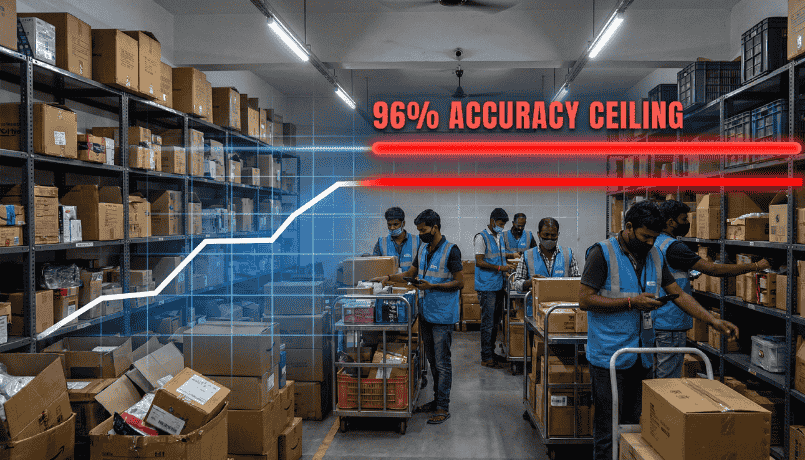
Most in-house fulfillment operations eventually stall at 95–96% order accuracy.
We see this repeatedly across founder-run warehouses handling 50–500 orders a day.
This is not a people problem.
It is a system’s ceiling.
At Varun Logix, we take direct operational accountability for accuracy audits, and this ceiling has appeared consistently across multiple client and pilot warehouses we have personally reviewed.
We are not extrapolating industry theory here—this pattern is based on our own audits, process redesigns, and post-change measurement.
Why the Order Accuracy Ceiling Appears in Warehouse Operations
Accuracy plateaus due to structural limits, not effort.
Most in-house teams assume accuracy improves with:
More training Tighter supervision Higher pressure
In practice, accuracy stops improving once human decision density crosses a threshold.
In our internal Varun Logix audits (non-public, ops-only reviews), manual picking environments consistently stopped improving beyond the mid-90s even after repeated retraining cycles.
Trade-off: Human-driven systems are flexible early—but brittle at scale.
Why Accuracy Plateaus Around 95–96%
Manual picking compounds small errors
Human picking error is probabilistic, not motivational.
In internal Varun Logix audits of manual pick lines, we observed error recurrence once pick density increased—regardless of picker experience.
These are internal observations, not universal benchmarks, and they vary by SKU complexity and bin density.
This explains why:
Extra supervision shows short-term gains
Accuracy reverts under volume spikes
Trade-off: Manual picking reduces tech cost, but caps reliability.
Slotting decisions are rarely data-driven
Poor slotting silently increases decision load.
At Varun Logix, our audits repeatedly found fast-moving SKUs placed based on convenience rather than pick frequency or confusion risk.
In these same audits, mis-slotting emerged as a dominant contributor to wrong-item dispatches—based on internal root-cause tagging, not external statistics.
Common patterns:
Similar-looking SKUs placed adjacently
Size/color variants sharing visual zones
Trade-off: Static layouts are easy to maintain—but decay as catalogs grow.
Where Most In-House Setups Break
Mixed bins create invisible risk
Space efficiency trades directly against accuracy.
In multiple Varun Logix warehouse reviews, mixed bins appeared only after space pressure increased—often without updating SOPs or QC logic.
This usually happens when:
Order volume grows faster than storage redesign
Temporary “fixes” become permanent
Trade-off: Mixed bins save space today and create returns tomorrow.
No scan-to-pick means no enforcement
Without scanning, accuracy relies on memory.
At Varun Logix, scan-less environments consistently failed to sustain accuracy improvements after process changes, especially during sales spikes.
This is an internal pattern we’ve measured across multiple redesign attempts—not a generic industry claim.
Trade-off: Skipping scan-to-pick lowers setup cost but removes enforcement.
Why Motivation Doesn’t Fix Accuracy
Humans don’t scale linearly
Effort does not scale predictability.
We’ve seen founders:
Add floor supervisors
Introduce penalties
Run daily accuracy standups
In Varun Logix–audited operations, these interventions produced short-lived gains but did not move the long-term accuracy ceiling.
Constraint: People adapt faster than processes—but forget faster too.
Staff churn resets accuracy
Labour churn erodes institutional memory.
In Telangana—particularly around Hyderabad outskirts—we’ve observed higher picker churn during festival and peak-sale months due to competing warehouse demand.
Operational impact :
Repeated retraining
Temporary staff during sales
SOP shortcuts under pressure
Trade-off: Lower fixed payroll increases volatility in execution quality.
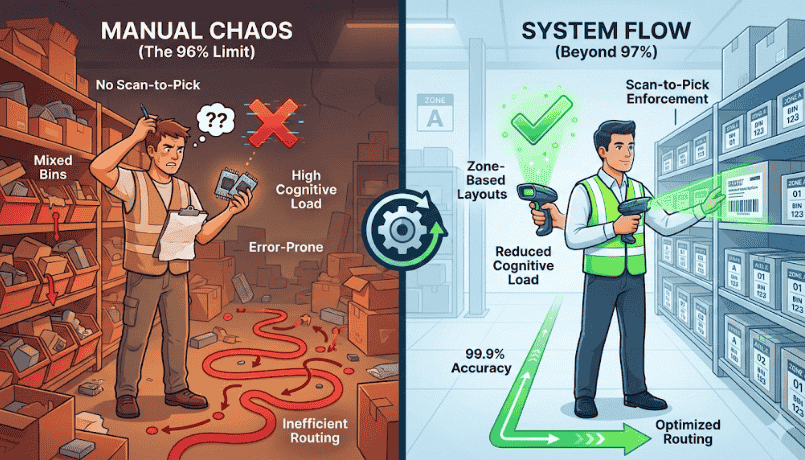
What Actually Pushes Accuracy Beyond 97%
Zone-based layouts reduce cognitive load
Smaller decision scopes improve reliability.At Varun Logix, zone-based layouts consistently reduced pick confusion during audits by limiting SKU exposure per picker.Observed effects (internal, context-specific):
- Faster onboarding
- Lower cross-SKU confusion
- More predictable QC outcomes
Trade-off: Zones reduce flexibility during sudden SKU mix changes.
QC must be a choke point, not a courtesy
QC catches system failures—not just human errors.
In Varun Logix process redesigns, QC acted as the primary error interception layer—not as a final checkbox.
Internal QC tagging repeatedly showed that upstream issues (slotting, labeling, bin logic) surfaced first at QC—not at customer returns.
Trade-off: QC adds cost—but removes blind spots.
Common Failure Modes
Systems fail when discipline breaks under load.
This approach breaks when:
Peak volumes override scan discipline
QC staffing doesn’t scale with dispatch
Layout changes happen without re-slotting logic
Signals to watch:
Accuracy dips only during sales
“Senior staff dependency” increases
Returns lack consistent root causes. Read more about silent operational losses in our related blog.
Who This Is Not For
Not every seller has hit this ceiling yet.This is not for:
- Sellers below 30 orders/day
- Single-SKU or mono-variant catalogs
- Dropship-only operations
- Fully marketplace-fulfilled models
These setups haven’t accumulated enough decision density.